Tag Archives: Bears Ears

Bears Ears and Grand Staircase-Escalante National Monuments: Other Times

Almost a month ago,* Tom put Red Rock Rondo: Zion Canyon Song Cycle on the stereo. Our friend Laura gave us the CD–signed by the musicians–close to twenty years ago. I was making cookies in the kitchen when I heard the opening music of “Marvelous Flood.” I had to come out of the kitchen to listen and to cry a bit for the beauty of the music, for old friends, for old times, and for the exquisite beauty of Southern Utah and the Colorado Plateau.

Like in 2017, I have been feeling angry and sad about the the president’s attempt to again vastly shrink Bears Ears and Grand Staircase-Escalante National Monuments. What I am not feeling this time around is surprised at these harmful, disrespectful, and–likely illegal–moves. I do have hope that lawsuits against this president will snarl and slow the depredations and that these land grabs will stop once and for all.

I read the news too much and I brood over the scores of photos I have taken of the Colorado Plateau. I have learned that my words and my pictures do not stop villainy. Yet, here I am on this page again–dreaming of democracy, peace, harmony, and rainbow deserts under blue skies.

Bears Ears National Monument 

In 2014 Tom and I drove to Natural Bridges National Monument on Utah State Road 95. We drove very near Bears Ears. I might even have a photo of at least one of the iconic ears. I am not sure, but the land all around us was like heaven (if you think heaven has lots of rocks and sand).

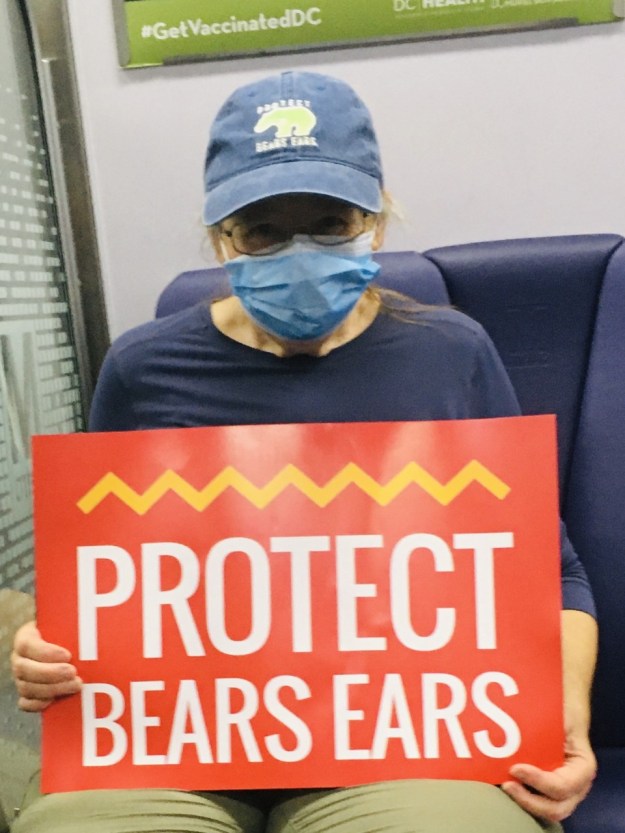
I had a Bears Ears tee shirt until it fell apart and I had a ball cap, but I lost it on the Metro.
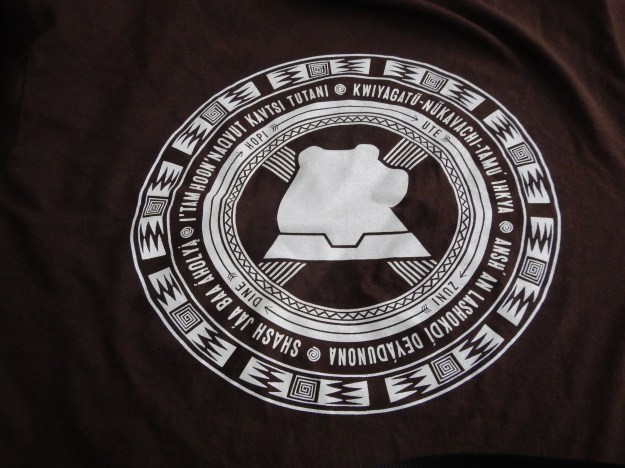
protect Bears Ears

protect Bears Ears tee shirt

protect Bears Ears circa 2021

Grand Staircase-Escalante National Monument

During the 2017 assault on the Grand Staircase public lands, I wrote five articles about the area.  Below are links to these articles:

I have learned that my words and my pictures do not stop villainy, but I won’t be silent.
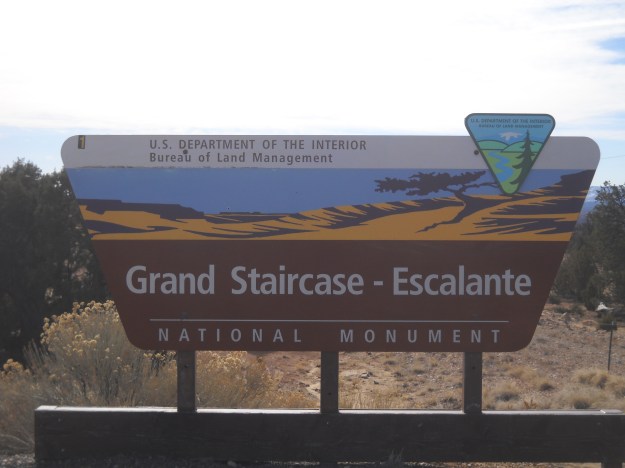
 

Grand Staircase Escalante National Monument, March 11, 2013

Grand Staircase-Escalante National Monument, March 11, 2013


*Almost a month ago Tom read a draft of this article. I always ask him to do so because I learned many years ago that we all need editing. Typically, I might have an overly elliptical statement, or I might need to stop writing sooner rather than later, or I might use the occasional wrong word. This time, Tom said he thought that people want to hear what I have to say now, not what I wrote about circa 2017. I have been thinking about this idea for the last month. Tom has a point: who wants to read my same old stuff?

It’s complicated for me, though. I love Kurt Vonnegut. Vonnegut was a writer-in-residence when I was a sophomore at the University of Michigan and I have never forgotten listening to him. I love Slaughter-House Five. That is where I learned about Tralfamadorian time. You probably need to read or reread Slaughterhouse-Five and maybe some of Vonnegut’s other novels to really understand this idea. Briefly, my take is that time is not linear and that the past, present, and future are not as simple as they appear. I think I may live my life in some sort of Tralfamadorian time. Last week, I walked in Washington, D.C. and I saw a banner of a malignant narcissist hanging from a U.S. Department of Justice building on Pennsylvania Avenue. I felt angry, sad, and fearful. Now, (maybe in need of comfort) I am walking in my imagination in the grand downtown Detroit of my early childhood. I am the little girl holding my mom’s and dad’s hands–I was always the baby of the family. I am the baby even now at 76 years old. It’s like that for me now, thinking about Southern Utah and Northern Arizona. Now, I am stiff when I get up from my chair and I have to take a minute to straighten up. However, part of me is still that young woman bounding over the rocks and jumping into the Colorado River. I hear and see my Navajo and Hopi students now, as they were then back in 1972. I can see a future where the water is gone, the ponderosas fail, and the indigenous history is no longer celebrated and protected. This might be where Vonnegut would say, “So it goes.”

Some of you did read what I wrote back in 2017. However, the beauty and love and pain and sadness remain new in my mind where time is not linear.

Some things are new with me, though. People die, others get sick or sicker, and some get stronger and do better. Many keep trying. Some are getting married and some are trying out for new teams. For all that these are challenging times, it is a beautiful summer here and I am seeing more butterflies than in the last several years.
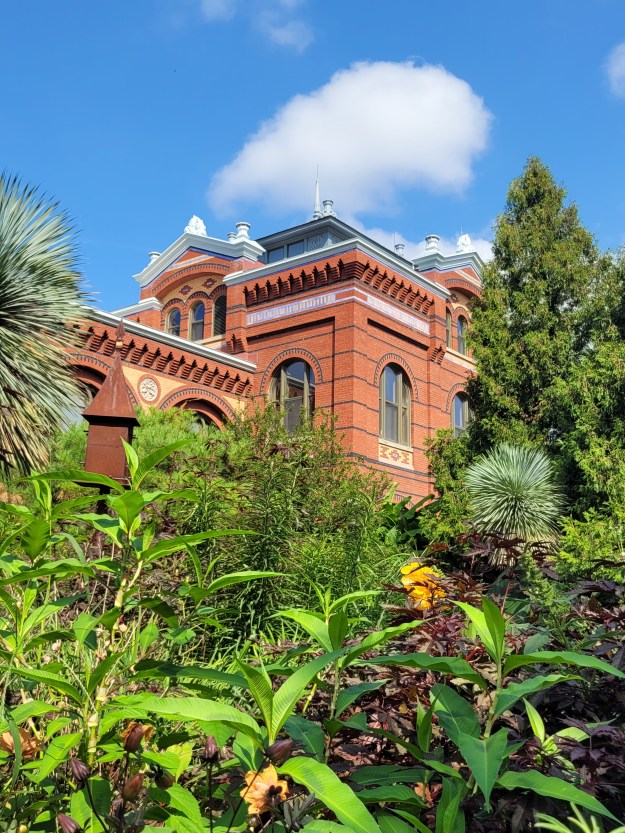
Smithsonian Arts and Industries Building from the Mary Livingston Ripley Garden, August 28, 2026, Washington, D.C.
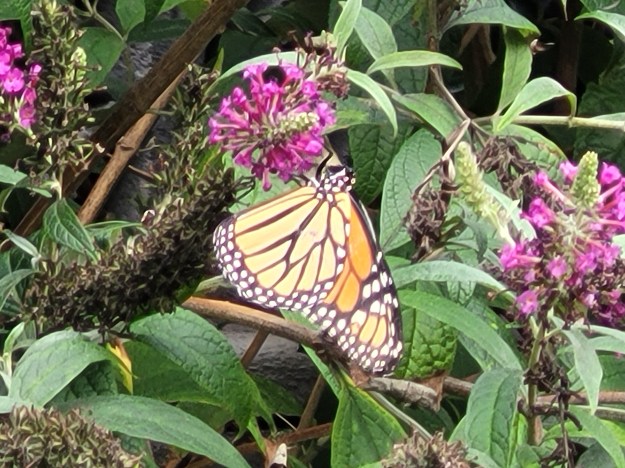
monarch, August 2026

Dolly Parton died a few days ago. My friend Daphne sent me  Dolly’s, “Light of a Clear Blue Morning.” I see the clear blue mornings in red rock country, from my balcony now here outside the capital city, and somewhere down the road in a place and time I don’t know yet.
 

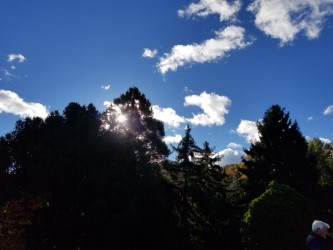
Autumn in Washington, DC

All day I have enjoyed watching the rain, sleet, and snow through my living room window.  I love such weather–if now more on paper than by actually venturing outside in it.  Today mostly, though, I have been thinking of flowers, trees, and the other parts of nature that give me solace.

It has been a challenging fall here in the capital area, and in many other places.  Flowers for family and friends, for the Carolinas, for Pittsburgh, for California, for the separated parents and children, for Bears Ears, for the sick, the hungry, and the lonely.  As a secular humanist agnostic, I don’t exactly pray, but I do remain hopeful (mostly).  I send good vibes. I mutter or whisper or chant: May you be well, may you be happy, may you have peace.  At least, here are some flowers:

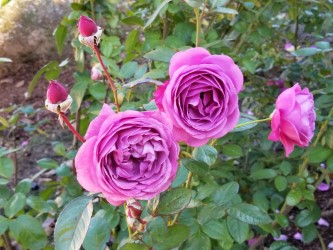
"Plum Perfect" floridbunda, Kathrine Dulin Folger Rose Garden

“Plum Perfect” floridbunda, Kathrine Dulin Folger Rose Garden

bumblebee, Mary Livingston Ripley Garden

bumblebee, Mary Livingston Ripley Garden

giant American elm near the National Museum of Natural Histor

giant American elm near the National Museum of Natural History

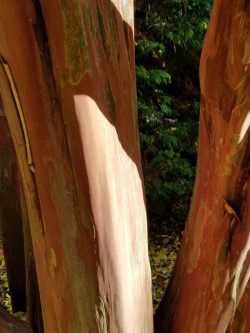
crepe myrtle, Gotelli Collection, National Arboretum

crepe myrtle, Gotelli Collection, National Arboretum

sweetgum leaves, Gotelli Collection, National Arboretum

sweetgum leaves, Gotelli Collection, National Arboretum

rose in front of Arts and Industries

garden, National Gallery of Art

garden, National Gallery of Art


toad lily, Mary Livingston Ripley Garden

toad lily, Mary Liivingston Ripley Garden

woodpecker, Mary Livingston Ripley Garden

woodpecker, Mary Livingston Ripley Garden

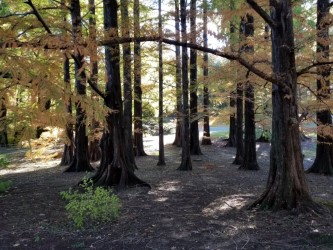
glade, National Arboretum

glade, National Arboretum

Gotelli Collection, National Aroretum

Gotelli Collection, National Aroretum


morning, Gotelli Collection, National Arboretum

Bee’s Knees and Bears Ears

So far this morning I have: skimmed the front section of the New York Times, worked on yesterday’s crossword puzzle, swept the floor (picking up stray oat shards that fell off the bran muffins), emptied the dishwasher, washed and dried clothes, plumped up the bath rugs in the dryer, tried to clean the cushions for the porch chairs, and corresponded with friends and relatives. All of this was not in an effort to be neat and efficient, but to pile up more tasks in order to avoid finishing this blog post. I began this post over three weeks ago, but I have not wanted to finish it. Part of this reluctance may be because, especially in this over-heated political climate, I want to avoid writing about political topics. As my friend Sharon said once, I do like to please people. I think, though, the bigger stumbling block is that I don’t know how to synthesize my ideas and feelings to express them succinctly in these few paragraphs. Synthesized or not, succinct or not, I am done waffling. Hold back the edges of your gowns, Ladies*, I’m going back in.

By the time I was 20 years old, I had pretty much given up the idea that politics could or would save the world. Earlier on, I had thought that non-violent political and social engagement could do that. That’s why I majored in political science. That’s why I had canvassed for Martin Luther King Jr. and had rallied against the war in Vietnam, had tried to organize to save Biafran babies, and had written about preventing the Alaskan pipeline. Well, the war in Vietnam did end eventually, but, in significant ways, the other causes haven’t worked out well.

I was 20 when the news of the Kent State massacre wafted into Zion Canyon where I was living. I felt pain and outrage for a bit and then the canyon and the sky took me back.

Zion Canyon

Zion Canyon

I spent three summers on the North Rim of the Grand Canyon. Back then we were mostly isolated from the news. Instead of the news, we listened to the wind in the ponderosas and the calls of the ravens.

ravens over the Grand Canyon

ravens over the Grand Canyon

When I was 22, I taught public school for one year in Page, Arizona, just outside the Navajo Nation. This was challenging for me because of loneliness, school bureaucracy, and fairly rampant ethnocentrism. This experience was also an honor for me because of the land outside my classroom, some caring colleagues, and the students themselves.

Those early years in wild country passed quickly and I settled in close to the ground with my husband, my children, and whatever little bit of land I had to garden. This is where I have mostly remained. However, sometimes I force myself to bring my head up.

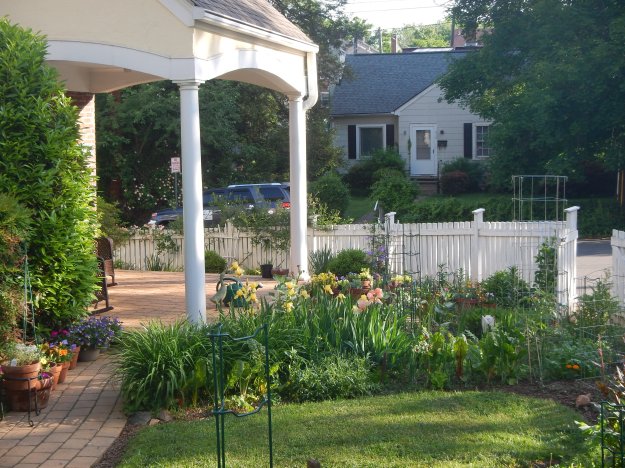
our garden

our garden

Bee’s knees: Already this spring, I have seen a few wasps, several bumblebees, several types of native bees, one cabbage butterfly, a couple of yellow swallowtails (or one twice) and another unidentified butterfly flying across the street. A few blocks away, I saw what looked to be a couple of honeybees among the flowers. I am hopeful that we legions of organic gardeners and farmers, and other assorted tree huggers will stem the tides of poison, disequilibrium, and destruction of our earth and its inhabitants. I plant my garden and I look (and find) signs of hope. Recently, I moved a clay pot that had over-wintered on my front porch and I startled a red-backed salamander. About a week ago, Tom discovered a garter (most likely) snake in one of my rock piles. Two evenings ago, I attended a presentation about non-honeybee pollinators at Ivy Creek Natural Area here in Charlottesville. It appears that many varieties of native bees and other arthropods are continuing to pollinate the flora for us, but we need to plant more native plants, and, of course, refrain from using poison.

bee and flower, Idaho Botanical Garden

bee and flower, Idaho Botanical Garden

Bear Ears: Ever since it came in the mail last Saturday (now almost a month ago), I’ve been wearing my “Protect Bears Ears” tee shirt to the gym and around the neighborhood.The few people that have commented on it seem to think this is an initiative to make sure that bears have adequate hearing protection.

No, it’s not about that. I have brought my head up from my comfortable dirt, rocks, and plants and I am becoming political again. Bears Ears is the name for an area of Southeastern Utah, east and south of Canyonlands National Park. Many Native Americans and environmental groups are calling on President Obama to name this area a national monument through the Antiquities Act. Some people  advocate leaving the control (and designation of use now and in the future) of this approximately 1.9 million acres of land to the state of Utah. Since I am adverse to, well, adversity, it’s a relief that people around here don’t seem to know what my shirt is referring to.  Confession: A couple of weeks ago realizing that many other gym goers’ tee shirts sport names of races, vacation spots, or bars, I chickened out and started wearing my wordless tee shirts again. This week, I toughened up and tried to put my body where my heart was.

My heart is with the native people of the Colorado Plateau—Diné, Hopi, Ute, Zuni and others. In many instances back in Page, my students, their families, and their cultures were not respected. It looks like there are still some people now who disrespect and disregard the cultures and histories of the groups who have lived in the Colorado Plateau hundreds (and thousands) of years before the pioneers settled there in the latter half of the 1800s.

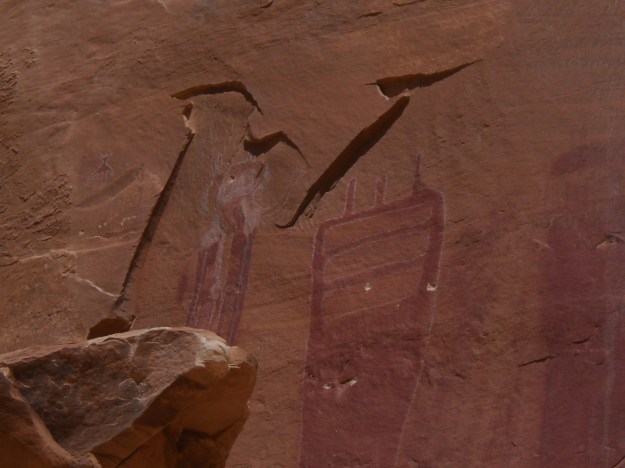
bullet holes in pictographs, Southern Utah

bullet holes in pictographs, Southern Utah

My heart is with the rock, sand, and sky of Southern Utah. I believe that this land should be preserved for all the inhabitants of this earth. I hope that President Obama will designate the Bears Ears a national monument.

Southeastern Utah

Southeastern Utah

There. I have said my piece and I am hunkering down close to the ground again.

protect Bears Ears

protect Bears Ears

For more information about Bears Ears, please see: The Bears Ears Inter-Tribal Coalition, The Grand Canyon Trust, and many articles in the Salt Lake Tribune and other periodicals available online.

* Thank you, William Carlos Williams and Allen Ginsberg (see the introduction to Howl and Other Poems).