Author Archives: lyndaterrill

Humbug, maybe

I realize I haven’t posted anything for a couple of weeks.  I have some excuses to give and then I will tell you the truth.

Excuses: My husband retired on November 30. Two days after that Tom went to India. He will be back in a few days. Meanwhile, I have been getting rid of more stuff as we get ready to leave Denver in January. This meant making trips to the Goodwill, packing boxes, and thinking about organizing our files.

My friend Jenny and I transported the silver Honda and the green parrot, Phoenix, back to Virginia where they originally came from.

Jenny in Salina, Kansas

Jenny in Salina, Kansas

Phoenix in Topeka, Kansas

Phoenix in Topeka, Kansas

Now at 11:19 AM (EST) Wednesday, December 12, I am sitting in a Starbucks—kitty corner to the Waffle House—off Berryville Rd. in Winchester, VA.

Actually, I didn’t stay long at that Starbucks, although I was in Winchester long enough that I finally understood the road system. I am still not sure whether the roads revolve around the big box stores or vice versa. On the brighter side, twice I was able to eat breakfast at the Apple Valley Café with my son Bill. Last Sunday, I was able to see my daughter Sarah and her husband Mike at the Eden Center in Falls Church, VA. We had café sua da, seafood soup, and then bubble drink to follow. Now I am sitting on the couch at my son Robert’s place in Pittsburgh.  I crave more air and light, but I love all the books, art, and other stuff and I just ate a bowl of delicious potato soup.

books and other things

books and other things

silver Honda in Pittsburgh

silver Honda in Pittsburgh

Truth: For most of my life—for decades after I became an agnostic—I loved Christmas: Snow on blue spruce, getting all the decorations on the tree, especially those handcrafted with yarn and construction paper.  I loved making the gingerbread cookies that went on the tree. I loved making the pralines and the pecan pie.  Tom, the kids, and I reveled in our own special holiday treats: chả giò, pupusas, Chinese dumplings, or chili verde. Even though I didn’t believe the religious part of the holiday, I believed fervently in the family and tradition and love and hope parts of it all.  A couple of my Christian friends laughed with me about my large collection of holiday music. I have everything from Pete Seeger and Joan Baez to the Congressional Chorus and the Boston Camerata, although now the CDs are in storage.

Something has happened to me these last few years. I was the one who had really believed in Santa Claus, even though I was the one who put the oranges in the beds*, candy canes on the tree, and the gifts from Santa under the tree. Now I feel gloomy and I feel sad.  Those emotions might be permissible as my Germanic soul waits for the Solstice, but I also feel petulant and that is less acceptable.  My husband has noted that I have tended to be gloomy around Christmas ever since my dad died.  That’s not right, so I am bucking up right now.  Robert and I are going to the bookstore and then to lunch.  I think I will buy an orange and a candy cane.  I will believe in family and tradition and love and hope because I think that is how I can live successfully close to the ground.

“I will honour Christmas in my heart, and try to keep it all the year. I will live in the Past, the Present, and the Future. The Spirits of all Three shall strive within me. I will not shut out the lessons that they teach!”   Ebenezer Scrooge from A Christmas Carol by Charles Dickens, 1843

*At our house Santa put an orange in each of our beds as the proof that he looked in on us while we slept.

candy cane with orange

candy cane with orange

New Orleans Pralines

I started the compilation of family recipes about six years ago.  It’s not finished, but I do manage to keep transferring the document file from one computer to the next. The objectives of this particular project were three-fold: divest myself of my battered gray file box with its motley collection of scraps of stained and faded recipes, share favorite recipes with my family, and finally, satisfy my apparently unquenchable need to organize.

Currently the recipe compilation is 22 pages long.  I finally tossed out the greasy old file box (circa 1970s), but I have noticed that I still can’t bear to throw away many of the scraps of paper.  I’m going to try again to do so today and also share a couple of recipes with you.  I’m leading off with my mother’s New Orleans Pralines.

Just two weeks ago, I braved possible interference by TSA officers to take a batch of pralines on the plane with us to the annual family meeting.  Of the many, more typical, holiday treats we enjoyed as kids (e.g., pecan pie, pumpkin pie, mince pie), the most iconic for us were my mom’s pralines.  Even then in our childhoods—long ago now—pralines seemed like a slightly unusual treat.  What I am telling you is, if you are not afraid of hot bubbling sugar and butter, my mom’s pralines are quick, easy, delicious, and the cook gets accolades she hardly deserves for the amount of work she puts in.  Here’s the recipe:

New Orleans Pralines
2C. firmly packed brown sugar
½ C. water
2 C. pecan nut meats
1/3 C. butter or margarine

Combine sugar, water, and butter.

Cook slowly stirring constantly until mixture boils
Add nutmeats
Boil slowly, stirring constantly, to 246° F (firm ball stage)
Remove from heat.
Drop by tablespoons on waxed paper, making patties 3” in diameter.

My notes: I think we had a candy thermometer and I also have used a tall glass of water to test the firm ball stage, but basically, you can tell the candy is done when the mixture begins to change from a glossy to a matte look and to thicken just slightly.  Then you have to quickly spoon the mixture onto the waxed paper.  If you start to drop the spoonfuls too soon, you will know because the candy doesn’t immediately start to set up. If you wait too long, the mixture could harden in the pan.  If you wait just a little too long, the last few candies might have a dull consistency, but everyone enjoys those just the same.

My take away: Apparently pralines resonate with many people.  I conclude that because when I typed in “pralines” in the Google search box two minutes ago, there were 784,000 hits in 0.27 seconds.  Well, I love pecans, brown sugar, and butter as much as the next person, but it’s channeling my mother that makes these treats so tasty to me. About cooking and life in general, I learned many things from my mother. I learned how to cook, then peel, and oil the warm potatoes to get just the right consistency for the potato salad, I  learned how to roll out pie dough, how to make smooth turkey gravy, and, of course, conjure up the pralines. What I really learned—reflecting years later—was more significant: Good work requires close concentration and a deft hand. Don’t make a big deal out of things. Keep your work surfaces uncluttered (I struggle with this). Be generous.

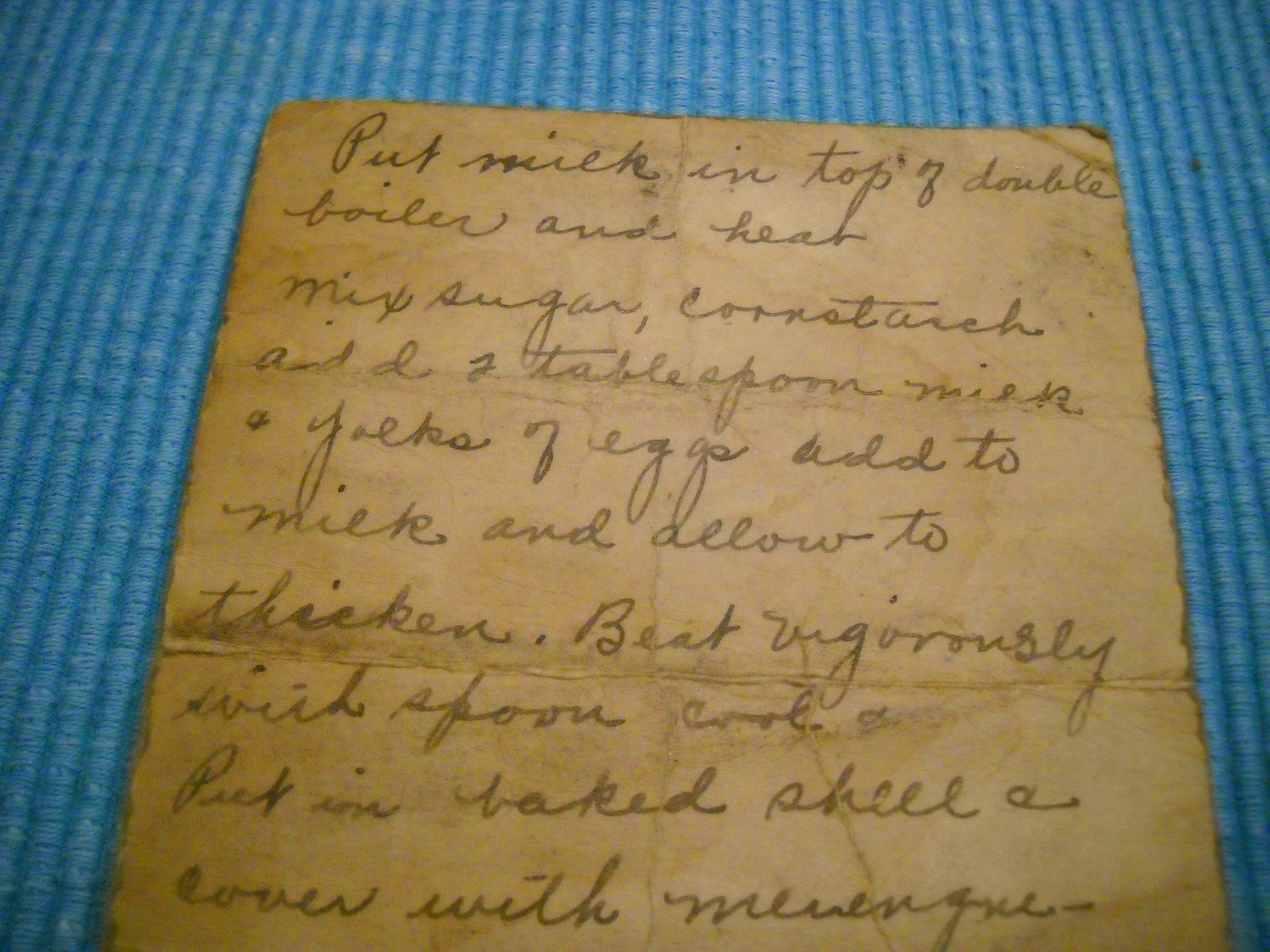
Bonus: In the residual pile of my mother’s recipes, I found a copy of my great aunt’s butterscotch pie written in her own hand, I am guessing at least 60 or 70 years ago.  You can see it below.  Now, I’m going to warm up a plate of leftover turkey, dressing, gravy, squash, and cranberry relish.  I lift my fork to us all and our happy memories. Happy Thanksgiving.

butterscotch pie#1


butterscotch pie#2

You Can’t Take It With You

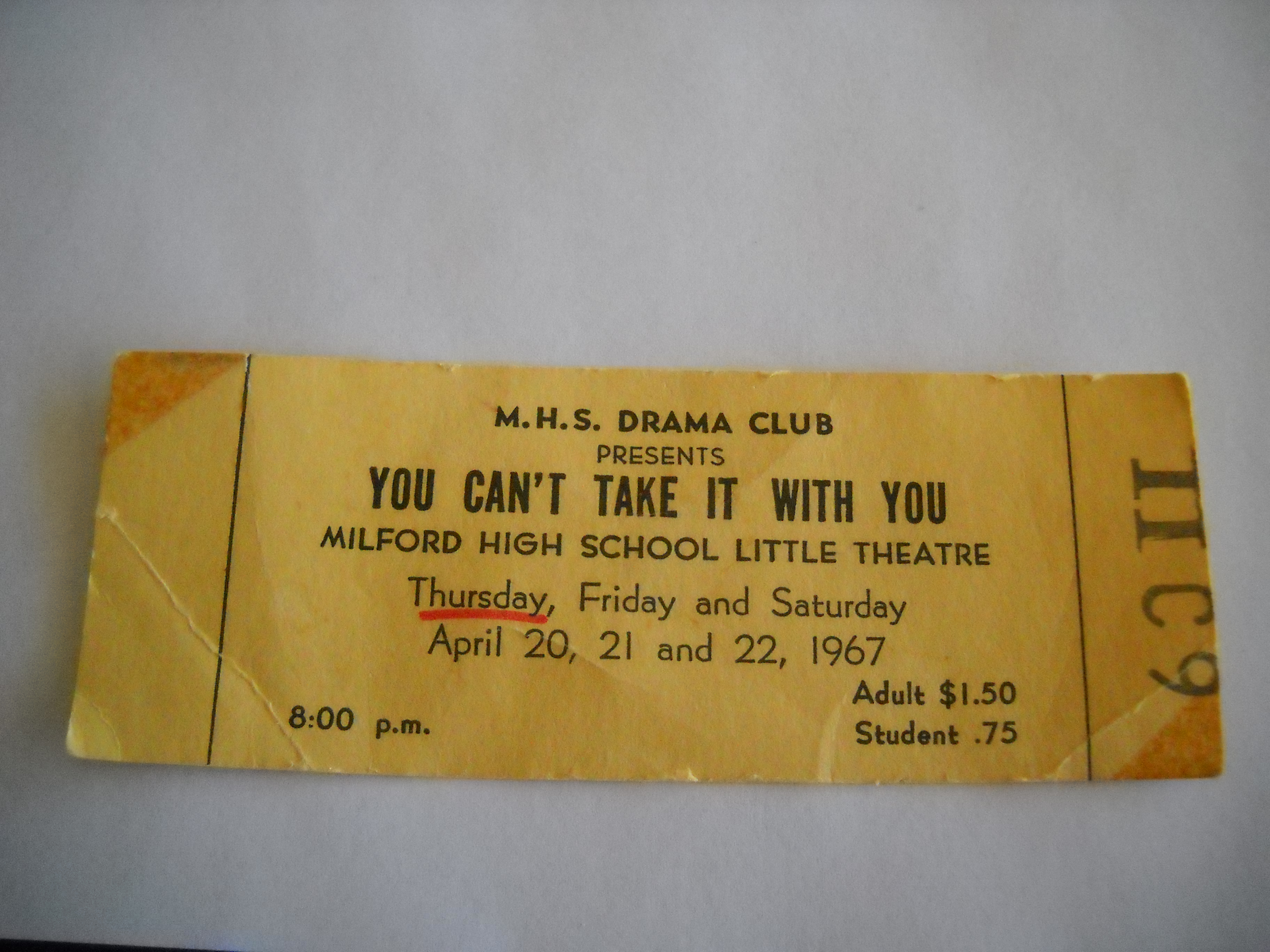
ticket stub, YCTIWY

They say that you can’t take it with you, but I’m not so sure that’s true. Right here on the arm of my chair I have a ticket stub from a production of Kaufman and Hart’s You Can’t Take It With You. This evidence suggests that I have been, in fact, taking this scrap of paper with me for decades.  The play was performed at Milford High School, Milford, Michigan in my senior year, 1967. I was a member of the drama club, but I only did mundane things like sell tickets.  What dramatic impulses I do have blossomed years later when I became a teacher.  I see by two old tape marks, that this ticket must have been part of the scrapbook that stayed at my  home for years. However, the scrapbook has traveled with me at least since my parents moved away from Milford over twenty years ago. About seven years ago I discovered that the scrapbook itself had mildewed. I tossed it out, but carted with me the actual photos, ticket stubs, and other souveniralia when we moved to Charlottesville, Virginia.  As part of my ongoing deaccession project, I saved many of the photographs, but jettisoned most of the odd bits and pieces. The items I abandoned include:

  • 7 junior high and high school attendance, achievement, and academic certificates
  • Camp Cavell (YWCA of Detroit) Birthday salutation
  • Henry Ford Museum Brochure
  •  2 “Installation of Officers” pamphlets from the Milford Bethel No. 68 International Order of Job’s Daughters plus my  purple and white Job’s Daughters headband (don’t ask—really)
  • 3 high school playbills: A Thurber Carnival, Diary of Anne Frank, and Twelfth Night or What You Will (1963, Pontiac Northern Senior High School, “in Commemoration of the Bard’s 400th Anniversary”)
  • various report cards and other school mementos
  • enigmatic broadside, “Satan’s Herald” from July 3, 1967 including the Blue’s Heaven Library books for loan that month, Hell’s Angels by Hunter S. Thompson and The Variety of Psychedelic Experience by R.E.L. Masters and Joan Houston
  • blue Romney (George) bumper sticker
  • Receipt for $84.05 from Robinson Auto Service Kanab, Utah, 4-1-73. The so-called mechanic put in a new generator and/or regulator, apparently backwards (which caused the car to stop working in the Sierra Nevada mountains 20 miles from Reno—another story)
  • and much more

Preserving these relics (and, pathetically, there were many) of my ordinary life must have been my attempt to take it with me.  My childhood was generally happy. I did a few memorable things in my happy, ordinary life. I have wanted to keep this happiness with me in my cozy nest of memorabilia, books, and papers. I think my husband and I are getting each other Kindles for Christmas. My nest is almost gone now, but I think I am okay with that.

Maybe what I can’t face is the meaning of the word “it” in you can’t take it with you.  I did take the corporeal ticket stub along with me. I did take the memories of my home in Milford, my family, my friends, and my school with me, too.  Last week I had yet another (in a long series) birthday and wrinkles have recently broken out in a new quadrant of my face. Today, I realize my nest of words and oddments were supposed to fend off the contemplation—let alone the fact of—death.  Really, I’m not gloomy; I’m just striving to face facts within the constraints of my sort of touchy-feely, but agnostic worldview.  I don’t have clouds with angels, I don’t have a great wheel that turns, but I do have poetry.  This morning, finally finishing up this blog that has been sitting on my table and my mind for two weeks, I have words in my head. I hear Yeats and Easter, 1916, the last lines of A Portrait of the Artist as a Young Man, and a Meskwaki poem, from The Little Square Review (Number 5-6, Spring-Summer 1968) that my friend Jan gave me for my birthday over forty years ago. Oh, and a touch of Tennyson’s Ulysses, and I bet my contemporaries know which lines I am hearing.

Tis not too late to seek a newer world.
Push off, and sitting well in order smite
The sounding furrows; for my purpose holds
To sail beyond the sunset, and the baths
Of all the western stars, until I die.
It may be that the gulfs will wash us down:
It may be we shall touch the Happy Isles,
And see the great Achilles, whom we knew
Though much is taken, much abides; and though
We are not now that strength which in old days
Moved earth and heaven; that which we are, we are;
One equal temper of heroic hearts,
Made weak by time and fate, but strong in will
To strive, to seek, to find, and not to yield.

Alfred, Lord Tennyson, 1833

I’m done. I will either throw the ticket stub in the trash or pocket veto it in my top dresser drawer.  Thanks for listening.

Next: Trying to write about death bogged me down some, so my next blog—in time for the holidays—will be about New Orleans pralines and other old recipes. See you then.

It’s October and the Leaves are Shaking

leaves, October

I’m writing “It’s October and the leaves are shaking” because I write it or say it every October. I’ve used this incantation ever since I plowed through Look Homeward, Angel sometime around 1966.  All in all, I might have been better served if I had begun with Light in August or A Portrait of the Artist as a Young Man. At least, I think I can safely say that those are good novels.  I’m too far away from literature classes to want to make a judgment about whether or not Look Homeward, Angel is a good book. Although I discarded my own copy of the novel last year (in the great book abandonment project), I am still fond of it.  I do worry that this fondness might point to a certain verbal over-exuberance and lack of discipline on my own part.  Okay, I admit to it, but I still love Wolfe’s words.

What I really want to write about This morning, I walked to Whole Foods to look for broccoli rabe, get something to eat for lunch, and sit outside and absorb Vitamin D while I copy edited my so-called book. I sat near an old guy who was either talking into his ear-piece or to himself or to someone whom I couldn’t see.  When the man got up to leave, I saw that he was indeed talking to himself or to someone who wasn’t visible to me.  Although it doesn’t reveal me to be the open-minded, egalitarian, and even-keeled person I wish I were, I was happy when the guy moved on.

Next, I went to the local library to check out a copy (the only one on the shelf) of Look Homeward, Angel and then on to Starbucks for coffee and more copy editing. One time I looked up from my work and saw the old man sitting across the street and then, later, he quickly walked past me.

My final errand was to walk to Safeway for milk and to search for the elusive broccoli rabe. A few blocks from the store, I saw the old man again walking quickly in my direction.  I changed direction, cutting through a plant median, so I wouldn’t have to cross his path again.

What’s with me? Did I see a ghost today–a ghost of all the mumblers, screamers, window peepers, burglars, and assorted troubled souls from other times and other places in my life? Maybe he was a ghost, but I am not sure whether he was a ghost from October past or from October yet to come.

O waste of loss, in the hot mazes, lost, among bright stars on this most weary unbright cinder, lost! Remembering speechlessly we seek the great forgotten language, the lost land-end into heaven, a stone, a leaf, an unfound door. Where? When?

O lost, and by the wind grieved, ghost, come back again.

Look Homeward, Angel

borrowed from the Denver Public Library, 10.30.12

Grandma in Idaho’s Raisin Cookies (I think)

I’m pretty sure the recipe below is my husband’s grandma’s recipe for filled raisin cookies. It certainly sounds like the hearty recipe (7 cups of flour!) that I remember. I am just a little bit concerned because this recipe mentions a food processor and Tom’s grandma was definitely from the pre-food processor era.  Still, I found this recipe in my document, recipes1v2, so I am going with it.

Tom’s grandmother, Alta May Walters, was born in 1896.  She grew up on a ranch in Southeastern Idaho near Blackfoot. Blackfoot is not far from the western border of Yellowstone National Park.  I loved the breezy way Grandma in Idaho (as we named her for our children) called Yellowstone, “the park” and I love the photo of her and her horse, Scout, up in the ponderosas at Island Park, Idaho when she was a little girl. Idaho is not for the faint-hearted.  In Blackfoot, summer would usually finally show up in June and—I swear and I have seen and felt it myself—winter could start closing back in at the end of August or early September.  In any case, Idaho seemed to be a place for two-fisted cookies— I remember no little meringues, no madeleines.   These cookies, like everything Grandma made, were delicious and seemed to just appear out of nowhere with no apparent effort on her part.  I’ve known my share of good cooks, but Grandma was the most efficient cook I’ve ever seen.

In the short time I knew Grandma she and I got along very well.  We both had four brothers and no sisters and liked it that way.  We sealed our relationship early on when Grandma asked me if I liked washing dishes.  I said yes, and, to keep myself honest, I‘ve liked washing dishes ever since.

It’s all I can do to keep from going into the kitchen and making a batch of raisin cookies right now.  What would I do with them, though?  Tom and I have (mostly) sworn off sweets except for weekends.  Even if today were Saturday, what would we do with all the cookies this recipe would make?  It sounds like a recipe that would make enough for the cowboys down in the bunkhouse. Here, it’s just Tom and I, our young friend Jenny who is staying with us, and the parrot, who isn’t allowed to eat sweets even on the weekend. 

Bakery of Desire One of Tom and my favorite fantasies is the one about opening a little bakery in our retirement.  Not likely unless we win the lottery and we never play.  In our bakery you could walk in and get a raisin cookie, a meringue or a madeleine, or perhaps a doughnut or a gluten-free peanut butter cookie.  In the meantime, maybe you can make this recipe yourself and get a taste of the old days.

Filled Raisin Cookies

Ingredients:
1 C sugar
1 C vegetable shortening
2 eggs, beaten
1 C milk
7 C flour
4 t. cream of tartar
1T baking powder
2 t baking soda
2 t vanilla

Filling:
2 C chopped or ground raisins
1C sugar
2 t flour
1C water
½ C chopped walnuts

Preparation: Cream sugar and shortening until light and fluffy.  Stir in eggs, milk, flour, cream of tartar, baking powder, baking soda, and vanilla. Roil dough thin. Cut round 2 ½ inch cookies and place on lightly greased baking sheets.

Put 1 teaspoon filling (directions below) on each cookie round and cover with another cookie round. Seal edges with a fork.  Make a small slit in top of each. Bake raisin cookies at 325º for 10 minutes. Store raisin cookies in tightly covered container.

To make filling:
Chop raisins in food processor or put through a grinder. Combine 2 cups chopped or ground raisins, 1 cup sugar, 2 teaspoons floor and 1 cup water in saucepan.  Cook until raisin mixture is thick. Let mixture cools then add ½ cup chopped nuts.

55 Perforated Index Cards (6 x 4 ruled) 49¢

Index cardsToday I am trying to discard a packet of notes I wrote for a paper on James Madison and his ideas of faction, separation in government, and related topics.  I believe I wrote the paper in 1973, so you might wonder why I have retained the notes.  Actually, there are several possible reasons.  First, I remember liking the format of the packet: all the cards in the Wire-in-dex COLORCARDS (blue) are bound together like a mini spiral notebook.  I admired this index card innovation and I hoped that it would keep my notes and my thoughts in order for a change. Second, until recently, James Madison was one of my heroes and so I have had a goodly pile of Madison paraphernalia to sort through and toss out.  Other than this packet, all I have left is a (mostly unread) copy of James Madison: A Biography by Ralph Ketcham tucked away somewhere in our temperature controlled storage unit.  From what I understood of him, Madison and I shared ideas about the nature of humankind. I admired the way he used these ideas to plan a government structure that could develop a strong (and, over time, increasingly democratic) society. Third, I think these notes reminded me of happy, idealistic times in Salt Lake City.

I wrote the paper for a year-long survey course called Main Currents in American Thought. I think I learned a great deal in this class, but I’m not sure because I’ve forgotten most of whatever it might have been.  I took this class before computers had spread out into the world and even before photocopying documents became ubiquitous.  Because of this, we students spent time reading various books and papers in a little room we called the Don D. Walker reading room (after our professor). I read lots of books in that room including, presumably, at least part of Main Currents in American Thought by Vernon L. Parrington. What I remember most and liked the most was reading Jefferson and Madison’s letters to each other where they talked about philosophy and politics, but also shared gardening information. You can now find Jefferson’s letters to Madison and others online at the Electronic Text Center, University of Virginia Library at http://etext.virginia.edu/toc/modeng/public/JefLett.html . One example is Abjuring the Presidency at http://etext.virginia.edu/etcbin/toccer-new2?id=JefLett.sgm&images=images/modeng&data=/texts/english/modeng/parsed&tag=public&part=111&division=div1  You can also access a variety of Madison’s papers from the Library of Congress’s American Memory project at http://memory.loc.gov/ammem/collections/madison_papers/mjmser.html

I guess I should tell you that back in the day it seemed like I was always trying to write papers on Madison.  What I mean to say is that I was trying to write at least one good paper on Madison.  I wanted to write a paper that clearly explained Madison’s well-reasoned, realistic, crafty, and humane ideas.  That didn’t happen, but now with the ubiquity of original sources available on the Internet, Madison’s own words are widely available, so no one needs my somewhat tortured and ineffectual explications.

For years I was miffed that at least a segment of the populace American populace seemed to be aware of Thomas Jefferson, but didn’t seem to know anything about James Madison. Also, from my own experience, I think some people conflate the Declaration of Independence and the Constitution and, furthermore, I am not sure if anyone remembers about the Articles of Confederation and all the trouble they caused.  I think I am in danger of jumping on a soapbox about the lack of information, misinformation, and dissing of my hero, so I think I will stop soon.

I need to tell you that it is the slavery thing that has finally made me disappointed in Madison.  Of course, I always knew that Jefferson, Madison, Washington, Monroe and others were slave owners. I only understood this fact in my gut, however, when I moved five miles from Monticello and 25 miles from James Madison’s Montpelier.  Okay, I still admire Madison in so many ways, but I have to distance myself from him for at least a while.

Here’s a quote from Madison from my notes (without, alas, clear bibliographic reference):

As there is a degree of depravity in mankind which requires a certain degree of circumspection and distrust…so there are other qualities in human nature which justify a certain portion of esteem and confidence.

I’ve just skimmed the notes one final time.  Now I am going to stand right up and dispose of them in the recycling bag.  I can’t even say good riddance. I think I am going to miss these cards, but, if I ever decide to write a good paper on Madison, I know I that I can find the resources online.

James Madison

James Madison

Note: So far in my new blog, I have gotten the most reader response about cookies. So, next entry, I plan on writing about Grandma in Idaho’s filled raisin cookies.  See you then.

Ain’t No Reason to Go in a Wagon to Town

Canyon Storm

“Canyon Storm” oil on canvas by Sally Hall

It took me a week or more to get accustomed to the altitude on the North Rim (about 8,000 feet). Just the walk from my cabin to the back dock of the kitchen where I worked wore me out. I also seemed to catch and then share strep throat with my coworkers. Those were minor obstacles. The hard part was slowing down and learning how to see the canyon in a more than just a superficial way.  At first, the canyon looks like a postcard. If you’ve been to the canyon, maybe you know what I mean. You’ve seen views of the canyon your whole life. I found it disconcerting to be there—at the Grand Canyon!!—and not have fireworks exploding or at least hyperbolic signs posted around saying things like, “This really is the fabulous place you have heard so much about.”

Lucky for me, by the time I shook off the altitude sickness and the streptococcus, I was also beginning to adjust to North Rim time.  I think it may be different in the national parks now—more sex, drugs, and cynicism probably. There were sex and drugs back in the day, too, but probably not the cynicism, at least among the Mormons and me. Instead of, or in addition to any s & d, the young workers were encouraged to put on performances for the dudes.  Why not? I’ve already told you we—the workers and the dudes—were a million (80) miles from anywhere and it was before TV made it up there, let alone WIFI and smart phones.  So, there were talents shows and comedy routines and singing to the dudes at dinner and singing them away in their Utah Parks Company buses in the morning.

Where was I? I remember: things to do at the rim.  You could walk out from the lodge patio and saunter along the little path to Bright Angel Point.  One time a friend introduced me to the joys of sparking in the dark.  Probably not what you think, and it certainly wasn’t what I was worried about.  When it is dark outside, if you crush mint (I think) Lifesavers in your mouth you can see little flashes of light.  It worked at Bright Angel Point and the Mormons did it, too. What astounds me right this minute is that when I just Googled what kinds of mints one uses for sparking, I came up with, “About 868,000 results (0.31 seconds).

Other pursuits Like the young creatures we were, my friends and I often gamboled around, in this case, on and off the rim. Just writing this discomfits the parent (for almost four decades) and old person (I’m trying to get used to it) in me.  The walk from the lodge to Bright Angel Point is only ½ mile round-trip.  We used to make fun of (to ourselves, not publicly) the moms and dads who held onto their children with grips of steel.  That was wrong and I have realized it ever since I held onto my own children with grips of steel at the Yellowstone hot springs. Also, I now feel nervous on narrow trails on mountains or in canyons. Furthermore, for some reason— sun glinting on bifocals, bigger butt, etc.— trails in general seem narrower than they used to. Even worse, the last time I was on the walk to Bright Angel Point, I huffed and puffed the whole damn ½ mile.  I could pretend that it was just because I wasn’t used to the altitude, but mostly it was because I was out of shape and getting older.  I am happy to report that I am now in much better physical shape, but I do keep getting older.  Enough unsettling reverie, I’m going back to talking about the rim of my youth.

On their days off, many of the young workers went hiking. One of the guys, who worked with me in the kitchen pantry, was an especially avid hiker. Throughout the summer, several people might take the 23 (give or take) mile hike cross the canyon on their day and ½ off and then catch a ride back from the South Rim to the North Rim. In the same amount of time, this particular friend could hike across the canyon and back. What would he pack for nourishing food?  He would take loaves of Wonder-style sandwich bread and squish them into handy, easily portable little balls.  While I never tried that one myself, this friend also turned me on to grilled peanut butter and jelly sandwiches.  I wish I had one right now, but I am controlling myself because I want to be in shape for the next time I hike the canyon.

Vocabulary malfunction I will name our friend Sally right here online. She’s on record somewhere anyway as Tom and my maid of honor. When she was a child, Sally spent many of her summers at the North Rim. Sally’s dad, a zoologist, studied the Kaibab squirrels that live only on the North Rim of the Grand Canyon. Sally’s dad was a genial person and I interacted with him many times through the years. I remember one particular conversation I had with him. I think it was by Bright Angel Point, when we were talking about the canyon. I am still embarrassed about this discussion. I kept saying the Grand Canyon was far-out. At that point in my life, I am sorry to say, I didn’t seem to have any other words to describe the place  As I said, he was a genial man, but Sally’s dad looked mildly disgusted at my words.  I had a college degree and was an English major type to boot.  There may not be words available to adequately describe the canyon, but I wished I had at least been able to come up with some more specific and less clichéd vocabulary.  I am sitting here now, though, and trying to think of apt modifiers and I still can’t do it. What? Fabulous, stunning, deep, wide, multi-colored, changeable, unchanging—I still can’t do it.  I just asked Tom to give me three words to describe the canyon.  He said, awesome, magnificent, and stupendous. See what I mean?  If you haven’t been there yet, I hope you get to go to the canyon some time and spend some time behind the postcard.

Ain’t no reason to go up, ain’t no reason to go down You can take U.S. Route 89A from Marble Canyon or from Fredonia, Arizona up to the Kaibab Plateau. At Jacob Lake, you take Arizona State Route 67 through the Kaibab National Forest to the North Rim.  Beetles, fires, and encroaching civilization have had their effect on the forest. Even so, I can still just barely imagine Rivendell back in there somewhere, but now the Orcs have been making inroads into the forest.

A few weeks into that first summer, our chef organized a party out of the national park and into the national forest.  That may have been because it was easier to drink out there—as I recall, our chef was partial to the now-defunct Olympia beer.  It was night in the forest and I sang (in my mind or aloud) lines from Joni Mitchell’s “Songs to Aging Children”:

Does the moon play only silver
When it strums the galaxy
Dying roses will they will their
Perfumed rhapsodies to me

I didn’t know what the lines meant then, but they struck a chord. If we were aging children then, I am sure I don’t know what we are now, but I still like the lines.

Point of information: I wrote my Masters’ thesis on An Analysis of the Imagery, Structure, and Theme in the Song-poetry of Joni Mitchell, so Joni and related characters tend to pop up in these pages. I guess it is my version of David Copperfield’s Mr. Dick. You probably shouldn’t bother to look for the thesis.  I think there is a copy in the J. Willard Marriott Library at the University of Utah. My original copy is in a box somewhere in our temperature controlled storage unit at 1525 Putt-Putt Place in Charlottesville, Virginia.  Back in the day, I dreamed of sending a copy of the thesis to Joni. At the dollar a page good copies cost back then, it would have been hundred-plus dollars that we didn’t have.  Now, I have a hundred dollars, but the time has passed.

One day I wondered alone in the forest and I found a bee-loud glade. One day, or maybe it was the same day, I considered jumping from the rim to a rock outcropping that would have let me actually stand within the Roaring Springs side canyon. My natural cautiousness stopped me. I found out years later that Tom had come across that same place and contemplated the same action. I guess if we had jumped— like some nature-crazed lemmings— into Roaring Springs Canyon, we wouldn’t have had to think about memories and meanings and mortality now.  On balance, it has been worth it keeping on, but I would have liked to have stood on that rock.

Time passes slowly when you’re lost in a dream Here I am, back at the dream (bars) where I began this reverie a few posts ago. I love thinking of my mother and father and my brothers in the pleasant peninsula of my childhood.  I love thinking of the canyon and those days and nights with my friends, the rocks, and the forest.  Time has passed, slowly or not, but Wordsworth was right:

… Though absent long,
These forms of beauty have not been to me,
As is a landscape to a blind man’s eye:
But, oft, in lonely rooms, and mid the din
Of towns and cities, I have owed to them,
In hours of weariness, sensations sweet,
Felt in the blood, and felt along the heart,
And passing even into my purer mind
With tranquil restoration

Lines Written a Few Miles Above Tintern Abbey,” 1798

Cookies on the North Rim

Canyon Storm

“Canyon Storm” oil on canvas by Sally Hall

In the summer of 1971 I worked in the kitchen of the Grand Canyon Lodge on the North Rim of the Grand Canyon.  Less than a week after I got to the rim, I fell in love with a handsome young cook. He was the one who was always seemed to be cutting his hands and the one who actually washed his hands. (I’m not compulsive about hand-washing, but you might be amazed at how rarely I saw food preparers wash their hands).  He worked at night. I’ll tell you his name: Tom. It’s easy to remember his name because he has been my husband for most of these last forty years. At night, Tom prepared the box lunches for the dudes who the following morning would ride the mules down the North Kaibab Trail to Roaring Springs. He also prepped food for the next day’s cooking and did general kitchen clean up. I worked during the day, but, besotted with him—just friends I said to everyone—I stayed up late talking with Tom while he worked. To have a more practical reason/cover for being in the kitchen, I decided to make cookies for the help.  As kids, my brothers and I had made lots of cookies (dream bars, hermits, Swedish nut cookies, brownies and more), so I thought I knew what to do.  I just had to figure out how to make cookies for, I’m guessing, fifty or more employees.  I did figure how and I remember I made the old standards like oatmeal or peanut butter. Later on, other friends got into making the cookies. Maybe this was partly because we were young and homesick even up there with the wind in the ponderosas and with all our brand-new friends from everywhere.  People would make runs off the rim for the chocolate chips and that was no mean feat. At least back then, there didn’t seem to be chocolate chips in Fredonia, Arizona (73 miles away), so usually people went to Kanab (80 miles away, i.e., 160 miles round trip for a few packages of Nestle’s Semi-Sweet Chocolate Morsels).  On occasion, people picked up the goods in Cedar City, Utah 168 miles away.

The bottom-line on the cookies The other workers liked the cookies. Most of the workers were high school and college students, who were energetic and open to making new friends.  Many of our co-workers were Mormons and cookies and milk seemed right up their alley.  There were also a few older workers at the rim, too.  One kindly, capable woman—my roommate’s aunt—managed the curio shop. Another older woman (I call her older now, not old, because I have now attained the age she was then) from Goshen, Utah supervised the housekeepers and one friendly older guy ran the gas station.  There was one dour old man—the night watchman.  I was a little scared of him. He seemed so scrawny, old, and wizened and his skin was mahogany (or something) from his years as a sheepherder.  Being the little Midwestern rube that I was, the man seemed exotic, but I didn’t seem to be able to connect with him.  Then along came those cookies, made in the romantic (but chaste) night kitchen. When the cookies were served, the sheepherder loosened up.  It was a long time ago now, but I think he smiled.  My lessons: cookies almost always work—there is something to that sharing food thing. There is something else I often still forget even now, so far down the road from that summer. All those clues we think we get from a person’s exterior (book/cover) aren’t true.

Tomorrow: Ain’t No Reason to Go in a Wagon to Town

Dream Bars

For almost three years now, I have been discarding books, clothes, papers and other relics of my life so far. I believe during this process I have been trying to discard physical bits while retaining the stories behind the things. I am just now finishing up a book about this process. My husband says the book is about mortality. I don’t know.  You can read that book when or if it gets published.  Today, though, I just wanted to go through the one remaining bag of books, magazines, recipes, and other oddments.  I’m going to start with a packet of my mother’s recipes.

Dream Bars
½ C shortening
½ C brown sugar
1 C flour
Mix to a crumbly mass and pat into a shallow pan, 8 x 12 inch
Bake in a mod. oven (375°) for 10 min
Remove mixture from oven & spread on top a mixture of
1C brown sugar
½ tsp. baking powder
2 eggs
¼ tsp. salt
1 tsp. vanilla
1 ½ C shredded coconut
2 Tablespoons flour
1 C nutmeats
Bake 20 more minutes
Cool slightly & cut in barsHermits
2 eggs
1 cup sugar
1 Tbs lemon juice
2 ½ cups pastry flour (sift before measuring)
1 tsp soda
¾ tsp cinnamon, allspice, nutmeg, salt
¼ tsp cloves
¾ cup butter or shortening melted
1 cup seed raisins
Beat eggs, add sugar, lemon juice. Mix flour & dry ingredients, sift
into egg mixture & beat until well blended. Add butter and raisins.
Drop by tsp on baking sheet
Bake at 375° 10 to 12 minutes.Date Nut Bread
2/3 cups boiling water
1 pkg pitted dates
¼ cup butter
2/3 cup sugar
¼ tsp salt
1 ¾ cup flour
½ tsp salt
1 cup walnuts
Put dates, butter, sugar in bowl, pour water over—add flour, nuts
line with wax paper Boston bread pans: 4 in diameter, 3 in deep,
5 in long
350° i hr.

making cookies

I’m quite sure that the dream bar recipe was written on the index card in my mother’s hand and with her recipe-writing narrative style, but I think the hermit recipe might be written by my aunt.  When my aunt died a few years ago, my sister-in-law gave me my aunt’s recipe collection.  I think through these years of winnowing, reorganizing, and moving, maybe I’ve inadvertently mixed some piles together.  Like all the ladies from way back in the last century, both my mother and my aunt wrote a fine hand, but I think my aunt was probably more likely to have used a fountain pen than my mom was. (Another clue is the recipe for Normandie Cake I see in the pile. If my mother ever made Normandie cake, I missed it, and that would never have happened).  I don’t think it matters and what am I doing writing to you about cookies anyway?

Note: Like some others of my own generation, I am somewhat uncomfortable providing certain specific types of information on the Internet. So, I just deleted my aunt’s and my sister-in-law’s names from this text. It reads better with their names, but, at least until I am more comfortable with this format, I’m going with general terms. I seem to want to spill my guts for the world to read, but, at the same time, remain vaguely anonymous.

I want to throw away these remaining scraps of paper, but I do not move It is another day and I plan on throwing away all of the index card recipes except for the one for dream bars.  I’ll do that on yet another day, maybe.  I also seem to be having a little issue throwing away the old-fashioned pickle recipes. I think that my mom and I made the nine day pickles one summer. Now that I’ve told you that, I am going to throw away the recipes right here at the Starbucks (Second and Fillmore, Cherry Creek, Denver 8.29.12) Days later: I still have the pickle recipe card sitting on the table next to me.

Where’s this story heading? See Cookies at the North Rim, coming soon.

Tree-of-Heaven

tree-of-heaven

tree-of-heaven

This summer I have sometimes been annoyed at my next plot neighbors at the Gove Community Garden in Denver, Colorado. I think this is because I a) am too officious b) am too quick to take unintended offense, c) have too much free time on my hands, or d) all of the above.  As I understand it, the rules, or at least the culture of the garden, directs community gardeners to keep the paths between the individual plots neat and free of plants.* This doesn’t seem difficult, and yet, I have suffered morning glories and tomato plants creeping into the buffer zone (about three feet wide) between the neighbors plot and mine. I admit to having ripped the offending morning glory tendrils and moving the tomato vines back to where (I thought) they belonged. I love morning glories, by the way, but they have the same strangling habit as their aggressive perennial cousin, bindweed.

What has incensed me recently—I am not exaggerating and it is a good thing that I rarely see anyone in my part of the garden space—is that these neighboring gardeners have let a two-trunked tree-of- heaven (Ailanthus altissima, http://www.nps.gov/plants/alien/fact/aial1.htm) grow to about eight feet high right by the fence that separates their plot from a National Jewish Health parking lot.  Don’t they know what they are doing by letting this invasive get a foothold?  I looked earlier today and, sure enough, more branches are coming up even though we’ve already had a hard freeze.

I keep asking myself why this little circumstance bothers me so much.  I want to go over and rip out the hellish little tree with my bare hands. Worse, I have been wanting to rat on the neighbors to the leaders of the garden.  That is, I want to be a vigilante or a stoolie—not too impressive for a supposedly liberal, high-minded person (as I like to characterize myself).  The ice cap is shrinking faster than ever, the candidate I don’t want to be president is gaining in the polls, and I am fixated on this one clump of tree-of-heaven.  Furthermore, you probably remember that the tree in A Tree Grows in Brooklyn is a tree-of-heaven.  It seems disrespectful to rail against the lovely metaphor, so what’s with me?

Sometime in late 1976, my husband Tom, our daughter Sarah, and I moved from married student housing at the University of Utah to a little house on Iowa Street near the university in Salt Lake City. We thought we were moving up. Some of our friends lived nearby and Tom could walk to class and work. Also, on this decrepit little street, we wouldn’t be so relentlessly (but cheerfully and pleasantly) surrounded by peppy young Mormon couples and families. The house itself was more of a shack with a lean-to attached to the back of it.  Nonetheless, for all of its drawbacks, the house had a good vibe.  We always thought that  a very poor, but very nice, old lady must have lived there before us.

Initially, Tom and I were excited about having a place for a little garden. Like I knew how to garden back then, but I was hopeful and enthusiastic.  Well, it turns out our tiny backyard was a forest primeval of tree-of-heavens and it contained more layers of dog excrement than I have ever come across before or since. So, Tom and I pulled out scores or hundreds or thousands of ailanthus.  That’s how I know how easy they are to pull up.  We piled the dead plants into a huge pile by the side of the house. I’m not sure what we did with the dog crap but I assume we bagged it and tossed it on the pile.   If I remember correctly,  the landlord (I think there is a better title for him, but I am playing it cagey because I see on the Internet that this person is still around in Salt Lake  and that he is somewhat in the public eye) said he would dispose of the detritus if we would clean out the yard.  I don’t think you are surprised that he didn’t do so in a timely fashion.  Finally, after weeks of waiting, we called the city and complained anonymously.  After that, the trees-of-heaven and the rest of the mess disappeared.

zinnias, Thumbelina mix

Zinnas, Thumblina mix from Burpee image

I planted tomatoes, beans, peppers and all of the standard stuff and we made a little lawn of tiny zinnias (probably Thumbelina mix). In May 1977 our son Robert was born.  We have a photograph of his small self and his mom in front of a wild mass of roses that bloomed all the more radiantly when the ailanthus grove had disappeared. Note:  I would have inserted a Google Images photo of a similar rose, but I did not find any as wild and fine as those I see in my memory.

______________________________________________________________________________

*I confess that I myself have let a clump of lamb’s ears grow into the path across from my other neighbor’s garden plot. I had my reasons: this neighbor had a bigger patch of lamb’s ears crowding the path, so I thought my  smaller clump provided symmetry, I like lamb’s ears more than morning glories, etc. Be that as it may, I dug up the lamb’s ears today and left a bag of them next to the tool shed in case anyone else wants them.