In November 2023, I mentioned that I had been working on an article about book banning that I wanted to post during Banned Books Week 2023. I also wrote that, “I am still planning to complete that article, but I need to ruminate a bit more before I finish.” I have taken more than “a bit” of time, as 2024’s Banned Books Week is next month! Although I have thought about book banning and censorship through these many months, I am still having trouble focusing on my topic. Actually, I think–as a lifelong reader and proponent of the First Amendment–that seems reasonable. Figuring out our society’s rights and responsibilities is an important and complex task.
I think what complicates the First Amendment and censorship issues for me is that in real life things are complicated. I have read (and continue to read), loved, talked about, written about, and taught many books that are currently on some censored lists (e.g., Lord of The Flies, To Kill A Mockingbird, Animal Farm, The Handmaid’s Tale, Beloved, Of Mice and Men, and many others). I also believe, though, that not every book is appropriate for every person–at a certain time, a certain age, or, sometimes, ever. However, I think that that choice resides with the individual (or, in the case of young children, a caring and responsible parent or surrogate), not some self-important group of parochial culture police. Right now, this minute, I am still pained by the memory of a Readers Digest article I read as a young teenager about the Communist Chinese depredations in Tibet in the 1950s. I read that article close to 60 years ago and I am not over it yet. However, as much as I wish I had come across that article when I was older, I am confident that it helped form my world view, which empathizes with others, acknowledges and respects diversity, and seeks equity and inclusion for all humans.
Concerning the First Amendment, I have supported freedom of expression throughout my life. I am proud to have annoyed teachers and employers throughout my life standing up for my and others’ rights to speak freely. Even though I was a shy person, I got an early start on speaking up. In first grade, the teacher had we children cutting out little strands of (apparently male) figures holding hands for “brotherhood week.” I asked the teacher (something like) is there a “sisterhood week?” The teacher laughed at my question.
I have always understood, though, that there are some limits on speech, such as the cliche about yelling “fire” in a crowded movie. Or, in this decade’s prime example, inciting violence at the U.S. Capitol.
To make this large and (to me) somewhat troublesome topic more approachable, I am going to break it down into a few smaller articles. I am not sure yet whether my comments will follow chronological order. I may revert to my early penchant for stream of consciousness writing. Note: This began when I was introduced to the technique when I read Thomas Wolfe’s Look Homeward, Angel: A Story of the Buried Life when I was 16.
Milford, Michigan, 1960s From kindergarten through graduate school, I have had my share of uninspired, ill-prepared, and, occasionally, bad teachers. I have also had many excellent teachers. Even better for me, several of these were English teachers, and English was my favorite subject. What I really need to do here is thank my good teachers. Thinking about ongoing efforts to control what teachers are allowed to teach in public schools, I have lately thought of my eighth grade literature teacher, Mr. Dennis. I can’t remember all the books we read in his class. I do remember we read Anne Frank: A Diary of a Young Girl, Hiroshima, and Journey to the Center of the Earth. We also probably read The Adventures of Tom Sawyer and possibly Animal Farm and at least a couple others. The reason I can’t remember for sure is that I was reading so many paperbacks on my own back then (from a small paperback bookstore available before school in an anteroom of the office). For example, I am not sure I picked up PT 109: John F. Kennedy in World War II or whether we read it for a class.
As I have been thinking about Mr. Dennis, other good teachers, and my home, school, and community upbringing, three ideas came to mind. First, with some few exceptions, such as people who may have had learning challenges, we students knew how to read. Second, even though my school–Milford Junior High School–was no hotbed of liberality, the teachers, the school administration, and our families seemed to think we were able to learn about serious, even terrible, matters such as the Holocaust and the bombing of Hiroshima, Third, those same teachers, administrators, and parents liked us to read. We had the aforementioned in-school bookstore, an easily accessible school library (not too big), and an easily accessible public library (not too big) only blocks away. In that one small junior high that I attended, I took three years of English, and one year each of literature, speech, and journalism. No wonder I have so many words coming out of me. Thank you teachers for helping me learn about the world that was bigger than my small Midwestern town of Milford, Michigan.
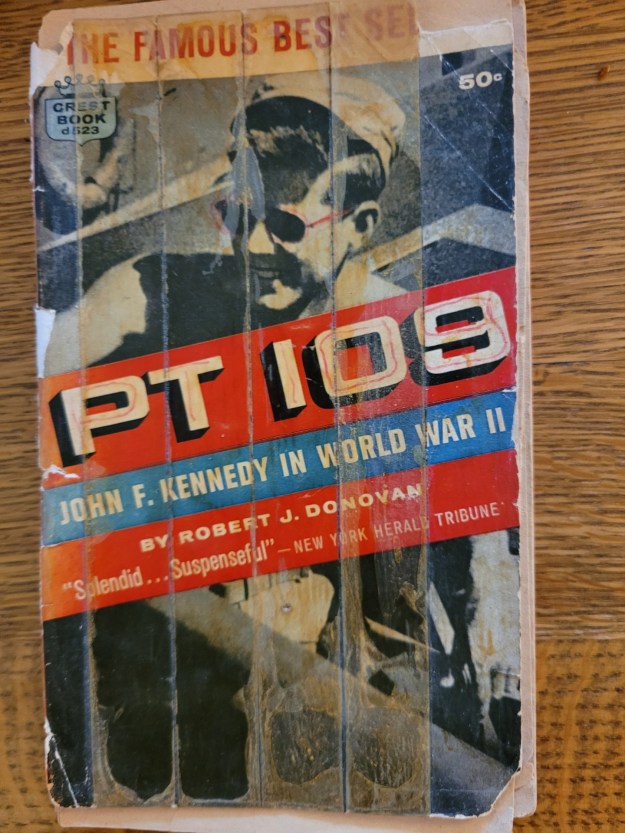
PT 109: John F. Kennedy in World War II, circa 1963
Part 2 to come soon
 Close to the Ground: Living Inductively