First Things First Before I address more of that distant past rattling in my brain, I want to write about four books I’ve read since Tom and I returned from our road trip in early June. Three of these books, and tangentially, the fourth, fit in with my general topics of book banning and individual rights. In the order I read them, the books are: The Bassett Women, by Grace McClure; This America of Ours: Bernard and Avis DeVoto and the Forgotten Fight to Save the Wild by Nate Schweber; The Heaven & Earth Grocery Store by James McBride; and The Door of No Return by Kwame Alexander.

four books
Note: I wrote the above paragraph over a week ago and then I lost my train of thought. In part that was just my usual mix of avoidance, inertia, and letting ideas percolate slowly through my mind. Also, though, we had our parrot friend Phoenix visiting last week, we’ve had friends over for dinners, I’ve worked in the native plant nursery and weeding invasive plants in Hillside Park, I’ve done my high intensity interval trainings, I’ve read too many political articles, and we’ve had–just when I thought a mild and lovely September here was a fading dream–it appeared. I am making myself sit here at the computer until Tom makes dinner. After I straighten up the kitchen, I am out the door before it gets dark. I will be back at the desk tomorrow morning, hoping my thoughts and words are ready.

Phoenix (photo by William Terrill)

Huron sachem butterfly in the condo garden
I’m Back and now I need to understand why I wanted to tell you about these books. I have been thinking about each of these four books, but how do I pull them together with a conclusion about the interplay between control and freedom? I think going back to the texts will help me understand.
The Bassett Women (copyright 1985 ) In May I bought this book at the Quarry Visitor Center in Dinosaur National Monument. Since early childhood I have loved books about nature and history and I have gravitated toward reading about indigenous peoples, the immigrants who came to this country, and the enslaved people who were brought here unwillingly. When I first visited the American West in 1970, I was beguiled by all the stories I heard, and that has not changed. These last three decades, I have also especially sought out memoirs and accounts of women in the West. When I say, “sought out,” I mean sought out in a desultory fashion. I am no scholar here; just a quirky reader. When I came home from the West this June, I read The Bassett Women right away. I enjoyed reading this history of Ann and Josie Bassett and other pioneers, ranchers, and outlaws (such as Butch Cassidy) in Brown’s Park in Northwestern Colorado. However, the composition teacher/editor in me didn’t think the writing was as clear as I wished, nor was the historical account as fastidious as it should have been. Still, the book will find a place on my bookshelf and I will continue to think about the women and men trying to survive in a challenging, if beautiful, environment.*

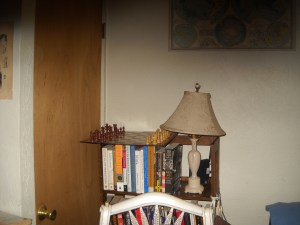
bookshelf
This America of Ours: Bernard and Avis DeVoto and the Forgotten Fight to Save the Wild (copyright 2022). I am searching for modifiers to describe how much I like this excellent book. I am almost giddy. When I am reading a nonfiction book, I like an index, a substantial bibliography, and many footnotes. This America of Ours has 33 pages (small font) of footnotes! In this book I read that historian and writer Bernard DeVoto was born in Ogden, Utah; Tom lived in Ogden when he was young. Bernard fell in love and married Avis from Michigan; I’m from Michigan. Bernard and Avis loved road trips through the West just as Tom and I do. Avis and Julia Child became close friends–bonding, at least partly, through food. Tom and I have loved cooking recipes from Julia Child’s cookbooks. More seriously, Bernard and Avis cared about preserving the land, the people, and the overall environment of the American West. This meant speaking up for forest rangers, small ranchers, and others who cared about the land. This meant speaking up against backroom political deals, and the anti-Constitution, anti-egalitarian, anti-immigrant schemes of Senator Pat McCarran (Nevada) and Senator Joe McCarthy (Wisconsin) who were in league with FBI Director J. Edgar Hoover. I need to stop myself from going on too much longer–just two more things. Author Nate Schweber follows the trail of attorney Roy Cohn from his early years working with the nefarious McCarran and McCarthy and identifies links to his protege, Donald J. Trump. On a happier note: I learned there is a DeVoto Memorial Cedar Grove off U.S. Highway 12 near Lolo Pass in eastern Idaho. Turns out, Tom and I have driven this road twice, the first time in 2015 and then again in 2018. Along this road in the Nez Perce–Clearwater National Forest we found the rivers, the forests, the rocks, and the sky moving and beautiful beyond words. We didn’t know about this memorial of ancient western red cedars. If Tom and I ever find ourselves on another western road trip, we won’t miss it again.
The Heaven & Earth Grocery Store (copyright 2023) I had read James McBride’s The Good Lord Bird a few years ago. I liked it and continued to think about it since. A month or so ago, when I saw The Heaven & Earth Grocery Store on display at a local bookstore, I wanted to read it. I say this as a person who tries to limit my reading of beautiful but difficult books–I can only take so much pain and brilliance. I was happy I took this chance. I’ve never been to Pottstown, Pennsylvania, but all my life I have traveled through Pennsylvania. Some of my earliest travel memories are of queasiness on the mountains and in the valleys of the Pennsylvania Turnpike. Tom and I have traveled through fog on steep and twisty back roads through damp forests in Pennsylvania. Now, I want to find the fictional Pottstown of McBride’s world in The Heaven & Earth Grocery Store. I want to go to Chicken Hill and see Malachi, “The Greatest Dancer in the World” and, perhaps, a magician. I want to see the kindness of Moshe and Chona. I want to feel the strength and uprightness of Nate and Addie, Paper, Miggy, and so many others. I want to hang out with Fatty and Big Soap. This book–full of the Depression, antisemitism, racism, sexism, poverty, and abuse–was an exhilarating read and it gives me hope for the country and the world. The book is also full of music, humor, hijinks, mystery, and love. I agree with the New York Times review by Danez Smith that, “The book is a murder mystery locked inside a Great American Novel.” If you like to read novels and are not afraid of pain and brilliance, this book may be for you.
The Door of No Return (copyright 2022) About two weeks ago, needing to calm down after finishing The Heaven & Earth Grocery Store, I made a beeline for the middle grades** shelf of the Friends of the Library store at Central Library, Arlington Public Library, three blocks from my home. I read many middle grade books. I do that because many are very well written, because middle grade books are usually good for a couple of sittings, and because, even when things are tough for the characters, some optimism pokes through. On the library shelf I found The Door of No Return. I read this 398 page book in several sittings, but it didn’t calm me down. This brave book in verse tells the story of Kofi an eleven-year-old Asante boy in 1860 (in what is now Ghana). The verse structure brings an immediacy to the narrative and, complex and gripping as the plot is, I think it is generally accessible to middle grade readers and old women alike. I just found out a sequel, Black Star, will be available by the end of this month. I am going to get on the library waiting list for it.
Conclusion I took you wandering with me through these books because I couldn’t let them go–even if they took me off the straight(er) and more narrow path of my exposition of book banning and individual freedoms. That’s how it is for me with words (and music and nature). There are however, some resonances between these four books and my overall concerns with books and an open and egalitarian society.
*Long before the Bassett family arrived in Brown’s Park there is the underlying history of the indigenous peoples who originally lived there. More on this topic in Book Talk, Part 3, forthcoming.
** Middle grades books are often considered to be for 8- to 12-year old readers. As far as I can tell, though, this designation is somewhat flexible. The majority of the Newbery Medal and Newbery Honor books are within in this category. So far, I have read approximately 145 Newbery winners.



 Close to the Ground: Living Inductively